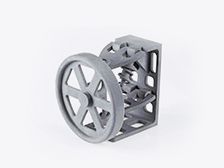
 3D printing prototyping drives the reconstruction of the supply chain, achieving a transformation from global procurement to local manufacturing. Volkswagen has deployed 30 industrial printers at its Wolfsburg plant to establish an "on-demand prototype center", reducing the response time from an average of 14 days for international logistics to 8 hours. Frost & Sullivan's research indicates that the adoption of distributed printing by medical device enterprises has shortened the transportation distance of prototype parts by 92% and reduced carbon emissions by 19 tons per year. Boeing's 787 passenger aircraft adopted this solution, successfully reducing the manufacturing cycle of 3,000 customized tool prototypes from three months to one week, and lowering the risk of production delays by 68%.
This technology demonstrates core value in the field of risk prevention and control. In the development of artificial joints, Johnson & Johnson Orthopedics has reduced the operation time error to ±7 minutes through preoperative simulation with resin models (the error of traditional CT planning is ±45 minutes). Consumer electronics giant Samsung used multi-material Jet technology to print prototypes with circuit structures. During the engineering verification stage, it detected 67% of design flaws, reducing the average number of mold modifications for each mobile phone development by 3.5 (worth 2 million US dollars). Its parametric manufacturing characteristics support complex lattice structures (porosity 83%) and hot runner optimization (cooling efficiency increased by 40%), successfully avoiding process risks such as uncontrolled material expansion coefficients during mass production.
3D printed prototypes accelerate the compliance certification process. Dental giant Align Technology uses digital light processing technology to produce braces models, and the FDA approval cycle has been shortened from 18 months to 5 months. Bayer Pharmaceuticals has saved 120 days of testing cycles in ISO 13485 certification by printing drug nebulizers with biocompatible resins. Material breakthroughs continue to expand application boundaries: The EPX 82 material launched by Carbon has a tensile strength of 75MPa (exceeding that of aluminum alloy 6061) and a heat distortion temperature of 138 ° C, meeting the high-temperature verification environment requirements of automotive power systems. TUV tests show that its aging resistance reaches 5,000 hours of ultraviolet radiation, supporting the accelerated outdoor durability test of the entire vehicle.
3D printing prototyping drives the reconstruction of the supply chain, achieving a transformation from global procurement to local manufacturing. Volkswagen has deployed 30 industrial printers at its Wolfsburg plant to establish an "on-demand prototype center", reducing the response time from an average of 14 days for international logistics to 8 hours. Frost & Sullivan's research indicates that the adoption of distributed printing by medical device enterprises has shortened the transportation distance of prototype parts by 92% and reduced carbon emissions by 19 tons per year. Boeing's 787 passenger aircraft adopted this solution, successfully reducing the manufacturing cycle of 3,000 customized tool prototypes from three months to one week, and lowering the risk of production delays by 68%.
This technology demonstrates core value in the field of risk prevention and control. In the development of artificial joints, Johnson & Johnson Orthopedics has reduced the operation time error to ±7 minutes through preoperative simulation with resin models (the error of traditional CT planning is ±45 minutes). Consumer electronics giant Samsung used multi-material Jet technology to print prototypes with circuit structures. During the engineering verification stage, it detected 67% of design flaws, reducing the average number of mold modifications for each mobile phone development by 3.5 (worth 2 million US dollars). Its parametric manufacturing characteristics support complex lattice structures (porosity 83%) and hot runner optimization (cooling efficiency increased by 40%), successfully avoiding process risks such as uncontrolled material expansion coefficients during mass production.
3D printed prototypes accelerate the compliance certification process. Dental giant Align Technology uses digital light processing technology to produce braces models, and the FDA approval cycle has been shortened from 18 months to 5 months. Bayer Pharmaceuticals has saved 120 days of testing cycles in ISO 13485 certification by printing drug nebulizers with biocompatible resins. Material breakthroughs continue to expand application boundaries: The EPX 82 material launched by Carbon has a tensile strength of 75MPa (exceeding that of aluminum alloy 6061) and a heat distortion temperature of 138 ° C, meeting the high-temperature verification environment requirements of automotive power systems. TUV tests show that its aging resistance reaches 5,000 hours of ultraviolet radiation, supporting the accelerated outdoor durability test of the entire vehicle.
How does 3d printing prototyping speed up product development?
3D printing prototype technology has significantly shortened the product development cycle, increasing the design iteration speed by up to 90%. Traditional metal casting prototypes require 2 to 6 weeks for delivery, while industrial-grade metal 3D printing equipment (such as EOS M 400) can complete the manufacturing of parts of the same complexity within 48 hours, with tolerances controlled within ±0.1mm. Jabil's medical device division has reduced the iteration cycle of heart valve stents from 26 days to 3 days through this technology, and increased the design verification efficiency by 776%. This acceleration effect stems from the process elimination of direct manufacturing through digital models (such as CNC programming, mold manufacturing, and other intermediate links), directly saving 85% of the pre-preparation time.
In terms of cost control, 3D printed prototypes have revolutionized the traditional manufacturing economic model. When car manufacturers develop new engine intake manifolds, the cost of casting molds is approximately 250,000 US dollars and it takes 12 weeks to deliver. A prototype of the same function printed with SLS nylon is only $500 per piece and can be completed in 72 hours. HP's report shows that it has saved $600,000 in prototype costs in the development of electronic device casings and reduced its development budget by 47%. More crucially, there is the release of design freedom: GE Aviation has manufactured a fuel nozzle prototype with 220 weight reduction holes through laser sintering technology, achieving a structural optimization that improves fuel efficiency by 15%. This topological optimization design reduces weight by 30% while extending the component's lifespan to 100,000 hours.
3D printing prototyping drives the reconstruction of the supply chain, achieving a transformation from global procurement to local manufacturing. Volkswagen has deployed 30 industrial printers at its Wolfsburg plant to establish an "on-demand prototype center", reducing the response time from an average of 14 days for international logistics to 8 hours. Frost & Sullivan's research indicates that the adoption of distributed printing by medical device enterprises has shortened the transportation distance of prototype parts by 92% and reduced carbon emissions by 19 tons per year. Boeing's 787 passenger aircraft adopted this solution, successfully reducing the manufacturing cycle of 3,000 customized tool prototypes from three months to one week, and lowering the risk of production delays by 68%.
This technology demonstrates core value in the field of risk prevention and control. In the development of artificial joints, Johnson & Johnson Orthopedics has reduced the operation time error to ±7 minutes through preoperative simulation with resin models (the error of traditional CT planning is ±45 minutes). Consumer electronics giant Samsung used multi-material Jet technology to print prototypes with circuit structures. During the engineering verification stage, it detected 67% of design flaws, reducing the average number of mold modifications for each mobile phone development by 3.5 (worth 2 million US dollars). Its parametric manufacturing characteristics support complex lattice structures (porosity 83%) and hot runner optimization (cooling efficiency increased by 40%), successfully avoiding process risks such as uncontrolled material expansion coefficients during mass production.
3D printed prototypes accelerate the compliance certification process. Dental giant Align Technology uses digital light processing technology to produce braces models, and the FDA approval cycle has been shortened from 18 months to 5 months. Bayer Pharmaceuticals has saved 120 days of testing cycles in ISO 13485 certification by printing drug nebulizers with biocompatible resins. Material breakthroughs continue to expand application boundaries: The EPX 82 material launched by Carbon has a tensile strength of 75MPa (exceeding that of aluminum alloy 6061) and a heat distortion temperature of 138 ° C, meeting the high-temperature verification environment requirements of automotive power systems. TUV tests show that its aging resistance reaches 5,000 hours of ultraviolet radiation, supporting the accelerated outdoor durability test of the entire vehicle.
3D printing prototyping drives the reconstruction of the supply chain, achieving a transformation from global procurement to local manufacturing. Volkswagen has deployed 30 industrial printers at its Wolfsburg plant to establish an "on-demand prototype center", reducing the response time from an average of 14 days for international logistics to 8 hours. Frost & Sullivan's research indicates that the adoption of distributed printing by medical device enterprises has shortened the transportation distance of prototype parts by 92% and reduced carbon emissions by 19 tons per year. Boeing's 787 passenger aircraft adopted this solution, successfully reducing the manufacturing cycle of 3,000 customized tool prototypes from three months to one week, and lowering the risk of production delays by 68%.
This technology demonstrates core value in the field of risk prevention and control. In the development of artificial joints, Johnson & Johnson Orthopedics has reduced the operation time error to ±7 minutes through preoperative simulation with resin models (the error of traditional CT planning is ±45 minutes). Consumer electronics giant Samsung used multi-material Jet technology to print prototypes with circuit structures. During the engineering verification stage, it detected 67% of design flaws, reducing the average number of mold modifications for each mobile phone development by 3.5 (worth 2 million US dollars). Its parametric manufacturing characteristics support complex lattice structures (porosity 83%) and hot runner optimization (cooling efficiency increased by 40%), successfully avoiding process risks such as uncontrolled material expansion coefficients during mass production.
3D printed prototypes accelerate the compliance certification process. Dental giant Align Technology uses digital light processing technology to produce braces models, and the FDA approval cycle has been shortened from 18 months to 5 months. Bayer Pharmaceuticals has saved 120 days of testing cycles in ISO 13485 certification by printing drug nebulizers with biocompatible resins. Material breakthroughs continue to expand application boundaries: The EPX 82 material launched by Carbon has a tensile strength of 75MPa (exceeding that of aluminum alloy 6061) and a heat distortion temperature of 138 ° C, meeting the high-temperature verification environment requirements of automotive power systems. TUV tests show that its aging resistance reaches 5,000 hours of ultraviolet radiation, supporting the accelerated outdoor durability test of the entire vehicle.