Stability Testing for an Eye Cream Formula: Three to Six Months, Budgeted
Stability and compatibility testing is the longest single block in an eye cream project, and it is also the block most often double-counted. Published windows put those reports at three to six months, which is the same span as the full new-development route once research and production are included. Run them in parallel and the calendar does not grow; run them one after the other and a six-month project becomes twelve.
Key takeaways
- Stability and compatibility reports take three to six months, and the report is what fixes the launch date.
- Sensitive-skin claims need patch test results planned separately from stability work.
- The testing window can run alongside packaging and filling preparation instead of after them.
- Sequencing is the whole budget: overlapping saves up to six months against a serial plan.
What the reports actually cover
A stability and compatibility report answers two questions that a sample cannot. The first is whether the formula holds its appearance, texture and separation behaviour over the tested period. The second is whether it behaves the same way in the pack you have chosen, which is why the container is part of the test rather than a later detail.
For an eye cream the second question carries extra weight. A rich texture in a jar and the same formula in a tube can age differently, and the difference is usually visible at the surface first. Sending the intended pack to the lab at the start avoids a second round later.
Patch tests belong to a different calendar
Any claim about sensitive skin needs patch test results, and those sit outside the stability programme. Planning them at the same time is fine; assuming that a stability report covers them is not. Ask which claims the supplier's standard test package supports, then add the ones your pack copy needs.
This is also where market position quietly enters the formula: a claim that requires an extra test window effectively moves the launch date, so decide the wording of the pack before the testing plan is signed.
Running tests in parallel with everything else
Testing rarely blocks packaging. Cartons, jars and pumps can be sourced while the formula is under test, and the filling slot can be booked on an expected date. Suppliers name ingredient sourcing, stability testing and packaging lead time as the three schedule risks, and all three can be worked at once.
| Item | Published window | Who needs it |
|---|---|---|
| Stability and compatibility report | 3–6 months | Every new formula and every new pack |
| Patch test results | Planned alongside, not inside, stability work | Products claiming suitability for sensitive skin |
| New development route | 3–6 months, research to production | Brands without an existing base |
| Existing formula route | 4–8 weeks | Adjustments to a library formula |
What to ask for when the report lands
A stability report that arrives as a single page saying "passed" is worth less than a dated record of what was measured. Ask for the test conditions, the container tested, the period covered and the observations at each checkpoint. Those four fields are what let you judge whether the result applies to the pack you are actually filling.
Then compare the report against the pack copy. If the label mentions a claim that the file does not support, that gap is cheaper to close before printing than after.
Finally, diarise the next date. Shelf-life statements age, formulas get adjusted and packs get restyled, and each of those events can restart part of the work. A project calendar that includes the next testing decision is more useful than one that stops at launch.
Where the waiting time actually goes
Three things stretch a testing window beyond the printed duration. The first is ingredient sourcing, particularly for actives that arrive in seasonal lots; a formula cannot be tested with the intended material until that material is in the lab. The second is the container, because compatibility work needs the pack that will go to market. The third is a formula adjustment made after testing started, which resets the clock on the part it touched.
Each of the three is worth one question at kick-off: which materials are on site, which pack is being tested, and what would trigger a re-run. Suppliers who can answer those without checking tend to be the ones whose windows hold.
Worked example: serial versus parallel testing
Suppose the stability window runs its full six months and the development route also runs its full six. Serial planning adds them: 6 + 6 = 12 months before the first saleable batch, because the second block only starts when the first finishes.
Overlap them and the calendar becomes the longer of the two rather than the sum, so the maximum is 6 months — a saving of 12 − 6 = 6 months. Even on the shorter windows the shape holds: 3 months of testing inside a 3-month development route is still 3 months, not 6. The caveat is real, though. Ingredient sourcing and packaging lead time can extend either block, and a formula change restarts part of the test, so the overlap only holds while the formula stays fixed.
Reading the testing-window chart
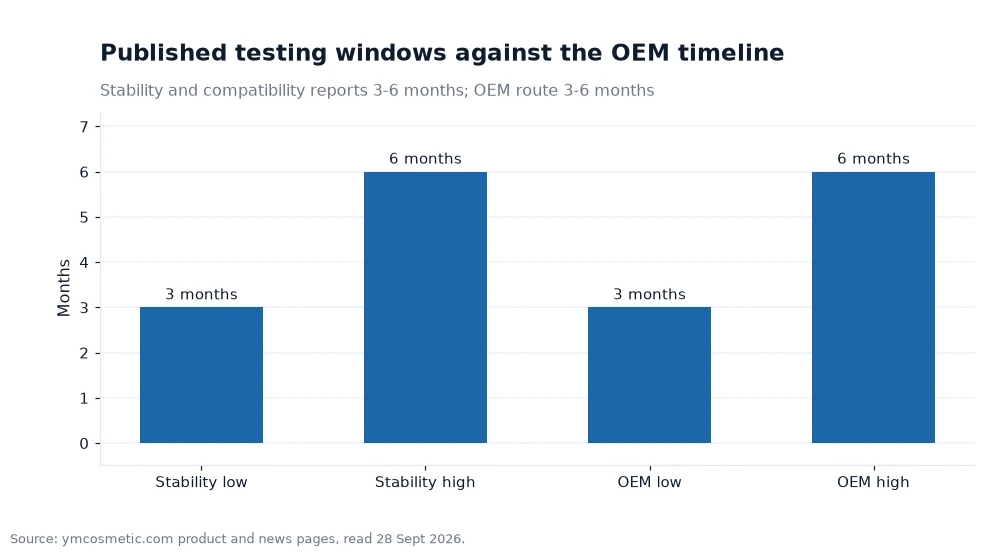
Two pairs of bars, same length, is the whole point. Because the testing window is not shorter than the development window, any plan that treats them as consecutive doubles the wait. Ask the supplier to put both on one dated chart when the project starts; if the two bands overlap on the page, the schedule is drawn correctly.
Frequently asked questions
Can stability testing be shortened for a small first order?
The tested period is set by the formula, not by the order size, so a 500-unit trial still needs the same report before a claim can be made about shelf life. What changes with quantity is the batch size, not the calendar.
Does a new pack need retesting?
Compatibility work is pack-specific for a reason: the same formula can age differently in a jar and a tube. If the pack changes after a report is issued, ask which parts of the compatibility work are repeated before you assume the report still applies.
How early should the pack be chosen?
Before testing begins, if possible. Choosing the pack later is what turns a parallel schedule back into a serial one, and packaging lead time is already named as one of the three risks that stretch a project.
Budgeting the waiting, not just the work
Put three dates on one page: the day testing starts, the day the report is issued, and the day the pack is expected. If the three fit inside the same window, the project has a launch date rather than a hope. Yunmei's natural skincare ingredients notes for private label eye cream work sets the active choice against those same testing decisions, and the OEM/ODM manufacturing pages state the published windows the arithmetic above uses. For a wash-off product with a shorter claim list, the men's cleanser range is a useful comparison of how much testing a simpler formula carries.
Both the testing windows and the development durations above are drawn from ymcosmetic.com, read 28 Sept 2026. The serial and parallel arithmetic is my own, applied to those published durations.[1].