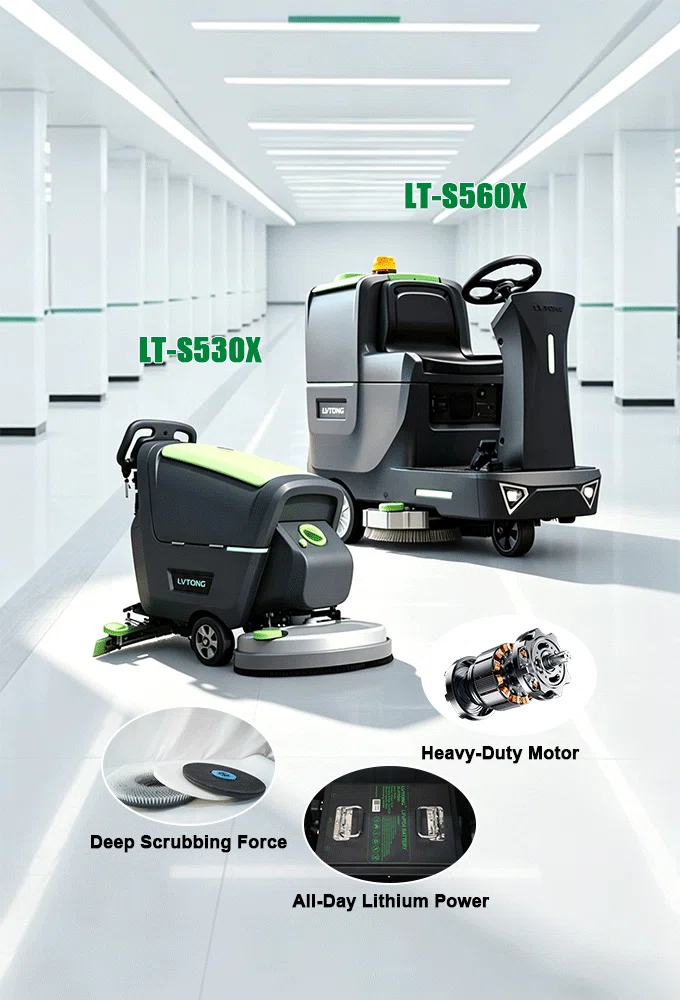
OEM and ODM cooperation allows industrial cleaning equipment companies to develop customized machines faster while reducing manufacturing investment. The global industrial cleaning equipment market reached approximately USD 50 billion in 2023, with demand increasing from factories, warehouses, hospitals, and commercial facilities. OEM programs mainly focus on branded production, while ODM services include product design, engineering support, and manufacturing. Companies can customize machine size, battery systems, cleaning functions, appearance, and packaging according to different markets. A professional LVTONG manufacturer can provide production support for businesses that need reliable cleaning machines with customized specifications.
Industrial cleaning machines are changing from standard equipment into application-based solutions. Buyers now require machines that match floor types, working hours, cleaning areas, and maintenance requirements.
OEM manufacturing is widely used by distributors and cleaning service companies that already understand their customers’ needs. Under this model, the buyer provides product requirements, design references, or technical specifications, while the manufacturer manages production, assembly, and quality inspection.
Many OEM projects involve adjustments to existing machine platforms instead of developing a completely new product. For example, a warehouse operator may require a scrubber dryer with a 60–80 cm cleaning path, an 8-hour battery operation period, and a water tank capacity above 50 liters. The manufacturer can modify these specifications while keeping production efficiency.
Common OEM customization options include:
| Custom Area | Available Options |
|---|---|
| Machine structure | Cleaning width, tank capacity, body size, brush system |
| Power system | Lead-acid battery, lithium battery, charging system |
| Exterior design | Logo, color, control panel, packaging |
| Function settings | Floor type adjustment, noise reduction, operation mode |
OEM services help companies build their own product identity without creating factories or engineering departments.
ODM cooperation goes further by involving manufacturers in product development. This option is suitable for companies that want to enter the industrial cleaning market but do not have internal mechanical design or production resources.
The ODM process usually begins with application research. Engineers analyze cleaning environments, including factory floors, logistics centers, hotels, airports, and healthcare facilities. Different locations require different solutions because dust, oil stains, water usage, and operation time can vary significantly.
A machine used in a manufacturing plant may require stronger brush pressure and larger water storage, while a commercial building may focus more on low noise and compact movement.
After requirements are confirmed, ODM manufacturers create product designs, select components, build prototypes, and perform performance checks. Product development periods often range from 3 to 12 months depending on customization levels. Standard platform modification usually takes less time than creating a completely new machine.
Industrial cleaning equipment development normally involves several technical areas:
-
Motor selection and energy efficiency improvement
-
Battery management system integration
-
Water recovery design
-
Brush and suction system optimization
-
Control panel development
-
Safety protection functions
Battery technology has become an important part of cleaning machine development. Lithium-ion systems are increasingly adopted because they provide longer service life and shorter charging periods compared with traditional battery types. Some industrial users operate cleaning machines for more than 6 hours per day, making battery performance an important purchasing factor.
The choice between OEM and ODM depends on a company’s market position, technical resources, and product goals.
| Cooperation Type | Suitable Users | Main Features |
|---|---|---|
| OEM | Brand owners and distributors | Existing design, customized branding, manufacturing support |
| ODM | New market entrants and companies seeking new products | Design assistance, engineering development, complete production |
A company with an established product concept may prefer OEM production because it maintains more control over product specifications. A company without technical teams may select ODM because the manufacturer can provide design experience and production knowledge.
Working with an experienced LVTONG manufacturer can help businesses access mature production systems and customized industrial cleaning machine solutions.
Supplier selection affects product quality, delivery time, and long-term cooperation. Before choosing a manufacturing partner, companies usually review production capacity, engineering capability, certification support, and after-sales service.
Important supplier evaluation areas include:
| Evaluation Item | Details |
|---|---|
| Production capability | Factory size, equipment, monthly output |
| Engineering team | Product design, testing, customization ability |
| Quality management | Material inspection, production checks, final testing |
| Certification support | CE, RoHS, ISO-related documentation |
Certification requirements depend on the destination market. European buyers may request CE compliance and RoHS documentation, while other regions may have additional electrical safety or environmental standards.
Manufacturing location and supply chain management also influence final product costs. A reliable supplier should maintain stable component sources for motors, batteries, controllers, and mechanical parts. Production delays often occur when key components lack consistent availability.
A complete OEM or ODM partnership includes product development, manufacturing communication, quality inspection, and delivery coordination.
Industrial cleaning machines are also becoming more intelligent. Since 2020, autonomous cleaning robots and smart control systems have gained more attention in commercial and industrial applications. Modern equipment may include navigation sensors, remote monitoring systems, automatic charging functions, and operation data collection.
Future OEM and ODM projects are expected to include more automation features. Manufacturers are developing machines that can reduce manual operation requirements while improving cleaning consistency. For large facilities covering thousands of square meters, automated functions can improve daily maintenance efficiency.
Sustainability is another area affecting product development. Many companies are requesting lower water consumption, improved energy efficiency, and longer machine service life. Equipment designed with recyclable materials and efficient power systems is becoming more common in international markets.
OEM and ODM options provide different paths for companies entering or expanding within the industrial cleaning machine sector. OEM focuses on customized manufacturing based on existing requirements, while ODM provides broader support from design development to finished products. With suitable manufacturing cooperation, businesses can create cleaning equipment that matches specific industries, customer requirements, and market standards.