Sizing a Purchase Before You Sign the Quote
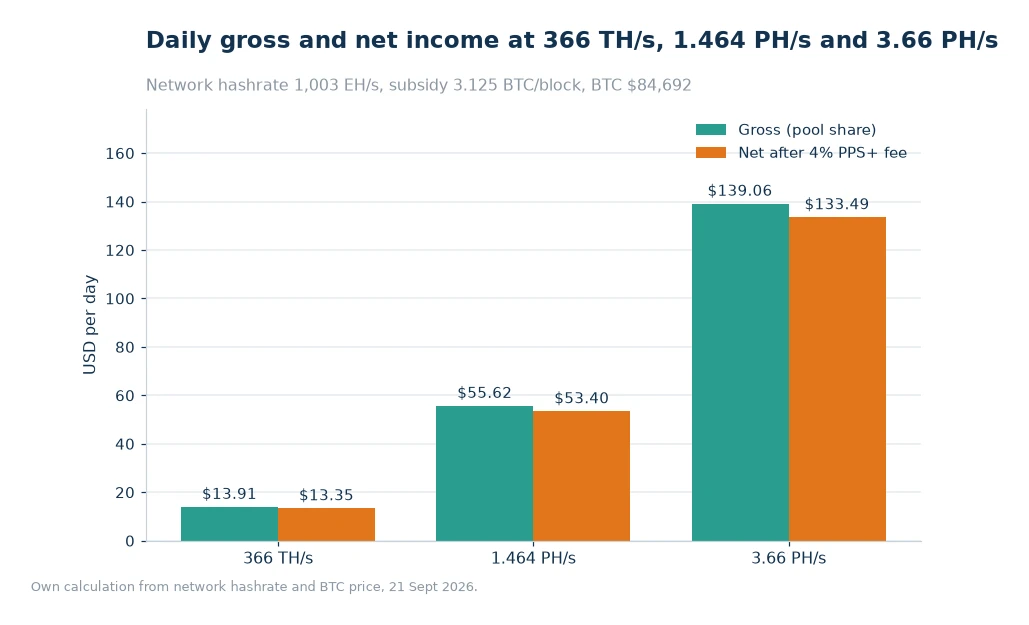
Two suppliers, two quotes, and hashrate printed in different units: the comparison looks impossible until both are converted to the same daily figure. At 366 TH/s the day is worth $13.91 gross and $13.35 net at the 21 Sept 2026 chain values. That single conversion is what a serious purchase decision starts with.

Key takeaways
- 366 TH/s produces 0.00016419 BTC a day, or $13.35 net after the listed block-reward charge.
- Quadruple the hashrate and the net rises to $53.40 a day; ten times gives $133.49.
- A quote that promises 400 TH/s but delivers 380 is a 5% shortfall worth about $0.67 a day at this scale.
- Convert every quote to net dollars per day before comparing price, warranty or delivery terms.
Two quotes, one comparable number
Suppliers quote in TH/s, in PH/s, occasionally in "units" that mean whatever the seller wants them to mean. A buyer who compares those strings directly is comparing labels. The conversion is not difficult, but it has to happen before the price discussion, because price per terahash is only meaningful once the terahashes are counted the same way.
The second conversion is harder and more useful: terahashes into net dollars per day. That figure folds in the network, the coin price and the settlement rules, and it is the number a household or a small operator can actually weigh against a bank transfer. Everything else in a quote is a term or a risk; this is the output.
What the tool asks for and what it cannot know
The ViaBTC Mining Calculator takes a coin price, a difficulty, a fee and an effective hashrate, then returns an estimate of daily output, including merged-mining rewards where they apply. It is a good way to test a quote's claimed hashrate against a realistic net figure without opening a spreadsheet.
What it cannot know is the machine's delivered hashrate, its power draw at your ambient temperature, or what the difficulty will be in six months. Those are assumptions you bring. Feed it the advertised number and you get an optimistic answer; feed it the number you expect after a hot afternoon and the answer is closer to the invoice.
For a second opinion on the hardware itself, the Miner Profitability Ranking shows how models compare at current price and difficulty. Use it to sanity-check a seller's claim that a particular box is exceptional, not as a substitute for your own arithmetic.
The delivered-hashrate gap
Every miner loses a little output in the real world. Dust, heat, a tired power supply and a firmware setting can each take a point or two, and together they routinely take five. At 366 TH/s, five percent is 18 TH/s, which is $0.67 a day at these values, or about $20 a month. That is not a reason to reject a machine, but it is a reason to size the purchase against delivered rather than advertised output.
The gap also changes the comparison between two quotes. A cheaper unit that delivers 93% of its label can beat a dearer one that delivers 99%, depending on the price difference and the cooling in your room. The only way to see that is to run both at the delivered figure, which is exactly what the calculator lets you do in a few seconds.
A year at three sizes
Annual figures make the scale differences obvious and expose how much of the decision is about site costs rather than hashrate. The table holds difficulty and price constant, which is a planning assumption rather than a forecast.
| Size | BTC per day | Net per day | Net per 30 days | BTC per year |
|---|---|---|---|---|
| 366 TH/s | 0.00016419 | $13.35 | $400.50 | 0.05993 |
| 1.464 PH/s | 0.00065676 | $53.40 | $1,602.00 | 0.23972 |
| 3.66 PH/s | 0.00164190 | $133.49 | $4,004.70 | 0.59929 |
The year column is the one that reframes a purchase. A single 366 TH/s unit produces about 0.06 BTC in a year at these inputs. Whether that is worth the asking price depends on costs the table does not contain, but at least the numerator is settled.
Worked example
Rebuilding the first row from network data, then applying the same logic to a quote that advertises a different number:
- Coins issued daily: 144 × 3.125 = 450 BTC.
- Every TH/s returns 450 ÷ 1,003,000,000, or 0.00000044865 BTC daily.
- At 366 TH/s: 366 × 0.00000044865 = 0.00016421 BTC, recorded as 0.00016419 after rounding.
- Gross: 0.00016419 × 84,692 = $13.91.
- Net at the listed 4% on the block-reward part: 13.91 × 0.96 = $13.35.
- Month: 13.35 × 30 = $400.50. Year in coin: 0.00016419 × 365 = 0.05993 BTC.
- A quote offering 400 TH/s at the same delivered ratio would gross 400 × 0.00000044865 × 84,692 = $15.20 a day; at 380 delivered it would be $14.44, so the label difference is worth $0.76 a day.
Sizing to a target rather than a budget
Most buyers start with a budget and ask what it buys. The reverse question is often more useful: what hashrate produces the daily figure I need, and what does that cost to run? Working backwards from a target prevents the common mistake of buying the largest machine the budget allows and then discovering the power bill is the real constraint.
Suppose the target is $400 a month net. At these inputs that is 366 TH/s almost exactly, before power. Add the site cost and the target moves up by however much the electricity takes. The arithmetic does not make the decision, but it narrows the field to machines that could plausibly serve the target and removes the rest from the shortlist. Running the target through the Profit Calculator with a delivered hashrate, rather than a label, keeps the shortlist honest.
The costs the quote leaves out
Power is the largest omission. A quote rarely states a wattage at your wall, and the difference between a lab figure and a July afternoon is material. Cooling, spares, a spare circuit and the space itself all sit outside the price on the page, and each one is a recurring or one-off charge that the daily net figure has to survive.
Delivery and duty are the second omission, and they are easy to forget because they arrive as separate invoices. The third is time: a machine that needs attention every week has a cost that never appears in a spreadsheet. None of these change the hashrate, and all of them change whether the purchase was sensible.
Frequently asked questions
Should I use advertised or delivered hashrate in the estimate?
Use delivered hashrate. At 366 TH/s a five percent shortfall costs about $0.67 a day, and ignoring it makes every quote look better than the machine will perform.
How much does a 366 TH/s unit produce in a year?
About 0.05993 BTC at constant difficulty, which is roughly $4,873 at $84,692 per BTC before power and other site costs.
Does the calculator include the settlement fee?
You can enter a fee rate, which is why the net column here applies the listed 4% to the block-reward component; the figure you get back is only as good as the rate and hashrate you supply.
Sign the number you can defend
Before signing, write the delivered hashrate, the daily net at a stated difficulty and price, and the all-in site cost on one page. If the page still makes sense at a five percent lower hashrate and a ten percent higher power price, the purchase is robust enough to discuss. If it only works at the optimistic end, it is not a plan.
Keep the fee schedule in view as well: the published rates are part of the daily net, and they belong on the same page as the quote rather than in a folder opened later.
Sources: the ViaBTC calculator, miner ranking and fee pages for the inputs and listed rates[1]. Values logged 21 Sept 2026: 1,003 EH/s network, 3.125 BTC subsidy, 144 blocks per day, BTC $84,692. Published 24 Oct 2026; annual figures assume constant difficulty and price.