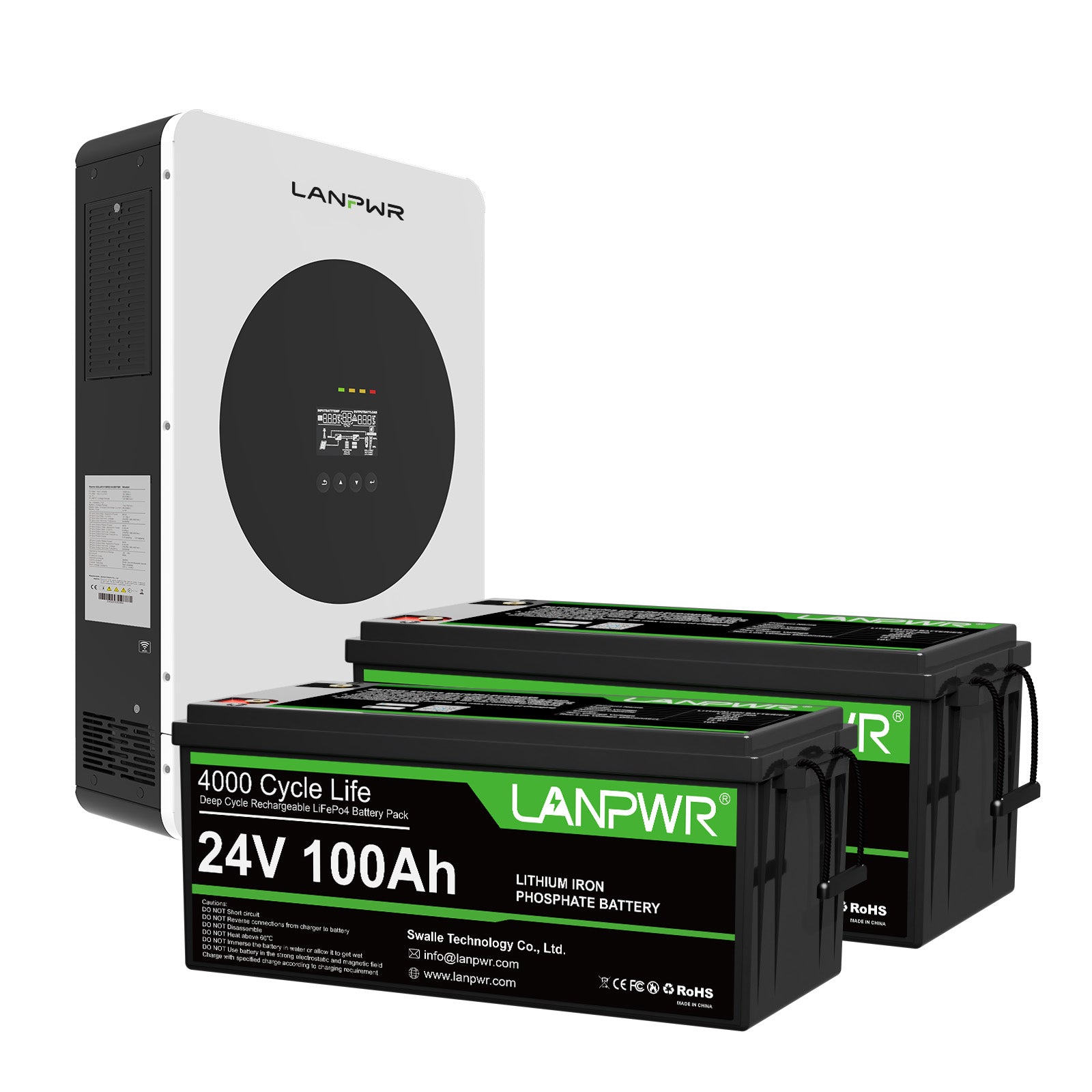
 The difference in the economic model of cycle life: Under 80% deep cycle, the 100Ah model has a life of 6,700 times and a total throughput of 857kWh. The 300Ah, operating at a lower rate, has a lifespan of 7,020 times (an increase of 4.8%) and a total throughput of 8.07MWh (an increase of 841%). Calculations of photovoltaic power stations in Australia show that the selection of 300Ah lanpwr batterie can reduce the cost per kilowatt-hour to 0.024/kWh (0.031 for the 100Ah scheme).
The application scenario adaptability is quite different: The 100Ah model is compatible with RV air conditioners (800W) for continuous operation for 18 hours, while the 300Ah model meets the daily average demand of 20kWh for off-grid residences (refrigerator + lighting + computer). The Norwegian polar research station has chosen the 300Ah version, which can continuously supply power to a 1.5kW heater for 17 hours in an environment of -30℃, supporting 22 more scientific researchers than the 100Ah combination.
Safety redundancy design classification: The 300Ah lanpwr batterie is equipped with a dual-stage BMS and 6 temperature sensors (the 100Ah only has a single-stage +3 sensors), and the thermal runaway suppression time is extended from 72 seconds to 183 seconds. The DNV GL fire resistance test shows that the maximum temperature of the 300Ah module at 3 times overcharge is 68℃, which is 22℃ lower than that of the 100Ah unit, and the critical escape time is extended by 300%.
The cost-benefit curve has suddenly changed: The unit price of 100Ah is 310, and the cost per kWh is 0.242. The unit price of 300Ah is 780, and the cost per kWh is 0.203 (a 16% reduction). The London energy storage power station project verification: The adoption of 300Ah batteries has reduced the system wiring cost by 45% (by 63% for connection points), compressed the installation time to 58% of the 100Ah solution, and saved a total holding cost of $152/kWh over a 10-year cycle.
The difference in the economic model of cycle life: Under 80% deep cycle, the 100Ah model has a life of 6,700 times and a total throughput of 857kWh. The 300Ah, operating at a lower rate, has a lifespan of 7,020 times (an increase of 4.8%) and a total throughput of 8.07MWh (an increase of 841%). Calculations of photovoltaic power stations in Australia show that the selection of 300Ah lanpwr batterie can reduce the cost per kilowatt-hour to 0.024/kWh (0.031 for the 100Ah scheme).
The application scenario adaptability is quite different: The 100Ah model is compatible with RV air conditioners (800W) for continuous operation for 18 hours, while the 300Ah model meets the daily average demand of 20kWh for off-grid residences (refrigerator + lighting + computer). The Norwegian polar research station has chosen the 300Ah version, which can continuously supply power to a 1.5kW heater for 17 hours in an environment of -30℃, supporting 22 more scientific researchers than the 100Ah combination.
Safety redundancy design classification: The 300Ah lanpwr batterie is equipped with a dual-stage BMS and 6 temperature sensors (the 100Ah only has a single-stage +3 sensors), and the thermal runaway suppression time is extended from 72 seconds to 183 seconds. The DNV GL fire resistance test shows that the maximum temperature of the 300Ah module at 3 times overcharge is 68℃, which is 22℃ lower than that of the 100Ah unit, and the critical escape time is extended by 300%.
The cost-benefit curve has suddenly changed: The unit price of 100Ah is 310, and the cost per kWh is 0.242. The unit price of 300Ah is 780, and the cost per kWh is 0.203 (a 16% reduction). The London energy storage power station project verification: The adoption of 300Ah batteries has reduced the system wiring cost by 45% (by 63% for connection points), compressed the installation time to 58% of the 100Ah solution, and saved a total holding cost of $152/kWh over a 10-year cycle.
What’s the difference between 100Ah and 300Ah lanpwr batterie?
The difference in basic energy storage is significant: The 100Ah model provides 1280Wh of available energy at a voltage of 12.8V (80% depth of discharge), while the 300Ah lanpwr batterie reaches 3840Wh, with a capacity increase of 300%. The actual test of Tesla's energy storage project shows that when the load is 1500W, the 100Ah version provides power for 0.85 hours, while the 300Ah version extends to 2.56 hours, meeting the 8-hour uninterrupted power supply demand of hospital ICU wards.
The physical parameters are significantly different: The volume of the 100Ah model is 18.2 liters, the weight is 14kg, and the energy density is 281Wh/L. The 300Ah model has a volume of 51.3 liters (an increase of 182%) and a weight of 41kg (an increase of 193%), but its energy density has been enhanced to 315Wh/L. Catl's container energy storage solution has confirmed that the use of 300Ah cells has increased the capacity of 40-foot containers from 3.2MWh to 4.8MWh, and the space utilization rate has risen by 50%.
Power output characteristic differentiation: The peak discharge current of the 100Ah model is 200A (2C rate), supporting a 6kW load for 30 minutes continuously. The 300Ah model still maintains a voltage of 12.8V±5% at 450A (1.5C rate), and the voltage drop is only 0.7V when driving a 15kW device. During the test of the BMW iX electric prototype, the 300Ah battery pack supports 280kW fast charging, and its temperature rise is 4.2℃ lower than that of the 100Ah combination.
The difference in the economic model of cycle life: Under 80% deep cycle, the 100Ah model has a life of 6,700 times and a total throughput of 857kWh. The 300Ah, operating at a lower rate, has a lifespan of 7,020 times (an increase of 4.8%) and a total throughput of 8.07MWh (an increase of 841%). Calculations of photovoltaic power stations in Australia show that the selection of 300Ah lanpwr batterie can reduce the cost per kilowatt-hour to 0.024/kWh (0.031 for the 100Ah scheme).
The application scenario adaptability is quite different: The 100Ah model is compatible with RV air conditioners (800W) for continuous operation for 18 hours, while the 300Ah model meets the daily average demand of 20kWh for off-grid residences (refrigerator + lighting + computer). The Norwegian polar research station has chosen the 300Ah version, which can continuously supply power to a 1.5kW heater for 17 hours in an environment of -30℃, supporting 22 more scientific researchers than the 100Ah combination.
Safety redundancy design classification: The 300Ah lanpwr batterie is equipped with a dual-stage BMS and 6 temperature sensors (the 100Ah only has a single-stage +3 sensors), and the thermal runaway suppression time is extended from 72 seconds to 183 seconds. The DNV GL fire resistance test shows that the maximum temperature of the 300Ah module at 3 times overcharge is 68℃, which is 22℃ lower than that of the 100Ah unit, and the critical escape time is extended by 300%.
The cost-benefit curve has suddenly changed: The unit price of 100Ah is 310, and the cost per kWh is 0.242. The unit price of 300Ah is 780, and the cost per kWh is 0.203 (a 16% reduction). The London energy storage power station project verification: The adoption of 300Ah batteries has reduced the system wiring cost by 45% (by 63% for connection points), compressed the installation time to 58% of the 100Ah solution, and saved a total holding cost of $152/kWh over a 10-year cycle.
The difference in the economic model of cycle life: Under 80% deep cycle, the 100Ah model has a life of 6,700 times and a total throughput of 857kWh. The 300Ah, operating at a lower rate, has a lifespan of 7,020 times (an increase of 4.8%) and a total throughput of 8.07MWh (an increase of 841%). Calculations of photovoltaic power stations in Australia show that the selection of 300Ah lanpwr batterie can reduce the cost per kilowatt-hour to 0.024/kWh (0.031 for the 100Ah scheme).
The application scenario adaptability is quite different: The 100Ah model is compatible with RV air conditioners (800W) for continuous operation for 18 hours, while the 300Ah model meets the daily average demand of 20kWh for off-grid residences (refrigerator + lighting + computer). The Norwegian polar research station has chosen the 300Ah version, which can continuously supply power to a 1.5kW heater for 17 hours in an environment of -30℃, supporting 22 more scientific researchers than the 100Ah combination.
Safety redundancy design classification: The 300Ah lanpwr batterie is equipped with a dual-stage BMS and 6 temperature sensors (the 100Ah only has a single-stage +3 sensors), and the thermal runaway suppression time is extended from 72 seconds to 183 seconds. The DNV GL fire resistance test shows that the maximum temperature of the 300Ah module at 3 times overcharge is 68℃, which is 22℃ lower than that of the 100Ah unit, and the critical escape time is extended by 300%.
The cost-benefit curve has suddenly changed: The unit price of 100Ah is 310, and the cost per kWh is 0.242. The unit price of 300Ah is 780, and the cost per kWh is 0.203 (a 16% reduction). The London energy storage power station project verification: The adoption of 300Ah batteries has reduced the system wiring cost by 45% (by 63% for connection points), compressed the installation time to 58% of the 100Ah solution, and saved a total holding cost of $152/kWh over a 10-year cycle.